Building a Side Project with AI Tools
Overview
Racecraft started as a question I asked myself: how far could I get building a real product entirely on my own, using AI tools to fill the gaps in my technical knowledge?
I’m a sim racing fan, and I noticed there was no good way to quickly get a decent car setup dialled in for a specific track and car combination without spending hours on YouTube or Discord. So I built one.
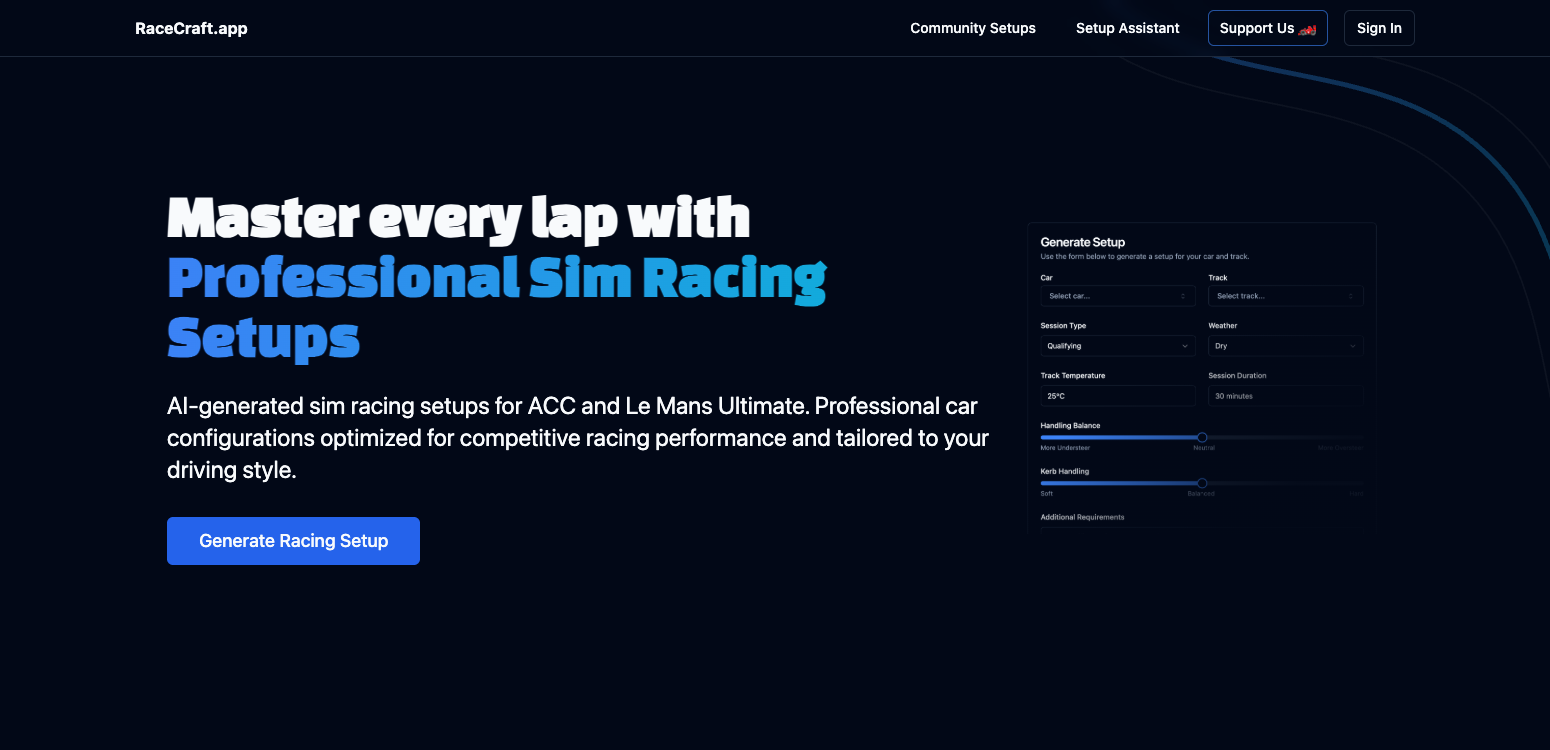
The result is a web platform that generates AI-powered car setups for Assetto Corsa Competizione and Le Mans Ultimate - tailored to your car, track, session type, weather conditions, and driving style. It has been quietly live ever since, building an audience and making a small amount of money in the background.
The challenge
Could a product designer with no traditional software engineering background ship a real, functioning, revenue-generating product from scratch - without a team, a budget, or months of runway?
How I built it
I leaned entirely into AI-assisted development. Cursor handled the bulk of the coding, with me directing the architecture and making the product decisions. Replit gave me a fast, frictionless environment to prototype and iterate without wrestling with local dev setup. Vercel handled deployment and made going live a non-event.
This stack collapsed the distance between idea and shipped product dramatically. I could move fast, test ideas with real users, and iterate without waiting on anyone else.
The site uses Clerk for authentication and a subscription model to gate the more advanced features. The setup generation itself is powered by an AI model that takes user inputs - car, track, session type, handling preferences - and returns a full, detailed configuration.
What it does
Users select their car, track, session type, and weather conditions, then dial in their personal preferences like handling balance. The platform generates a complete car setup optimised for those parameters - suspension, tyre pressures, differential, aero, the lot.
There’s also a Setup Assistant for more conversational, guided help, and a community setups section where users can browse and share configurations from other drivers.
Outcome
Racecraft has been live and running with minimal intervention. It has a growing user base, covers its own costs, and earns a small amount passively each month. More than anything though, it proved the point: the gap between idea and shipped product has never been smaller. A designer who is willing to embrace these tools can build independently - and that changes what’s possible.